 |
| Image by Rao Advisors |
We're often asked - what is the best way to do well on the SAT/ACT? Here's the 35,000 ft. overview.
- Pay attention when you sign up for the SAT: When registering for the SAT, the first time or the nth time, ALWAYS leave the list of four free college score recipients blank. Why would you want a school to know your scores before you know how well you did?
- Complete the test trifecta: Take your SAT in August between the 10th and 11th grade (prior-prior year of high school graduation); and the ACT in September, so that you are well-prepared for the all-important PSAT-11 in October. The PSAT-11 is also the qualifying test for the National Merit Scholarship competition.
If you do well on the SAT or the ACT, you never need to take those tests again! This frees up time for 11th grade academics and extracurricular activities. - Take the test(s) only once: Prepare well, take all the official mock tests at home; postpone the test date if you must, but take the test(s) only once. See our post here.
- Practicing rather than studying: All
three tests are measures of scholastic aptitude. Algebra II/Pre-Calculus courses will have provided you with a solid Math
foundation. Your English II, AP Human Geography, and AP World
History learning experiences will have given you an excellent English
foundation. So, you prepare for these tests more by practicing than studying.
- Practicing is a two-step process: You sharpen the knowledge and skills required by practicing the content of the tests; and then, you sharpen your test skills by practicing on the tests themselves. These two are related activities but wholly different.
- Exploit free resources: The
Khan Academy, the College Board, and the ACT Academy are outstanding
resources for practicing content – free, and official! Even tutor-learner
online sessions are free, thanks to Schoolhouse.world, launched in Jan 2021. To practice test-taking, both the SAT and ACT offer numerous free official mock tests, tests that were previously administered.
- Practice with a trusted peer: Students
often under perform not because they lack ability, but because they
lack consistent practice, accountability, motivation, engagement, and
peer reinforcement. When a student learns with a peer, they show because their partner is counting on them. Peer learning increases motivation and reduces tutoring fatigue. Explaining concepts to a buddy deepens mastery. These tests are timed and competitive, so practicing with a peer simulates test pressure.
- Invest in diagnostics and forensic analysis: When you practice test-taking, find out why you got a wrong answer, and close the learning gap before you take the next mock test. Review point #6 in the step-by-step instructions below.
Taking Practice Tests
Here are excellent tips developed by the College Board for the digital age.
Taking a full-length practice test on Bluebook is one of the best ways to prepare for the real test. Digital practice tests simulate the real test experience, including adaptive modules and built-in tools (like highlighting and answer elimination). [Paper practice tests are still useful for content review, but they don’t reflect the new format or timing]. Our advice is that you prioritize digital practice tests.
The College Board offers 10 full-length digital practice tests through the Bluebook app. These include:
- Practice Tests 4–6: Previously available digital tests
- Practice Tests 7–10: Newly added in 2025, combining fresh questions and select items from the original paper-based Tests 1–3
- Note: Practice Tests 1–3 were removed from the Bluebook in February 2025, but their content is partially reused in updates Tests 7–10.
You can find both the Bluebook digital tests and the updated PDFs on the SAT Suite Practice Tests page.
The digital test is shorter because it relies on adaptive testing. That means the test changes based on the students' answers, with the goal of reducing the time students spend answering questions that are either too easy or too hard.
The digital test is shorter because it relies on adaptive testing. That means the test changes based on the students' answers, with the goal of reducing the time students spend answering questions that are either too easy or too hard.
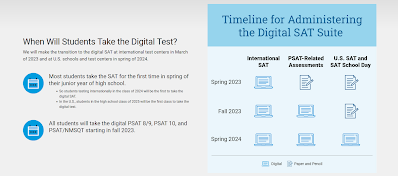 |
| SAT Digital Suite. Image Courtesy: The College Board. |
Truth, and nothing but the truth - in just one minute! Thanks @salkhanacademy! https://t.co/BruTl7KFp1— Rajkamal Rao (@rajkamalrao) November 4, 2019
Do Colleges Prefer the SAT over the ACT?
Colleges are indifferent to which test you take. The concordance tables
that map the ACT scores to the SAT have consistently shown that this
policy makes sense. Statistically, one can be nearly 100% confident that
an ACT score falls within a narrow 30-point SAT score range.
Both the SAT and the ACT are attempting to stay relevant as there is increasing pressure from groups who lobby for the elimination of these tests altogether. Groups such as FairTest have exploited disruptions caused by Covid to convince more than 1,800 colleges and universities to go test-optional. But there are many colleges that still require the SAT/ACT for college admissions, and when test scores are submitted, colleges will consider them as one more data point to make admissions decisions. Besides, test-optional does not mean test-blind. In Texas, scoring a minimum of 480 in reading and 530 in math (Super scoring is NOT allowed) is required to avoid colleges imposing Texas Success Initiative requirements.
Both the SAT and the ACT are attempting to stay relevant as there is increasing pressure from groups who lobby for the elimination of these tests altogether. Groups such as FairTest have exploited disruptions caused by Covid to convince more than 1,800 colleges and universities to go test-optional. But there are many colleges that still require the SAT/ACT for college admissions, and when test scores are submitted, colleges will consider them as one more data point to make admissions decisions. Besides, test-optional does not mean test-blind. In Texas, scoring a minimum of 480 in reading and 530 in math (Super scoring is NOT allowed) is required to avoid colleges imposing Texas Success Initiative requirements.
Since 2024, it has become clear that the test-optional party at many top
colleges is finally coming to an end. We tracked the announcements of
various elite schools, including UT Austin, in this Facebook post.
Colleges are beginning to realize after four years of experimentation
with student admissions and performance that test scores better help
predict students’ college grades, and their chances of graduation and
post-college success. Grades alone are not as accurate a predictor because of
issues like grade inflation that make it difficult to assess a student’s
work.
Note about the ACT Science section
STEM-focused students will probably do better on the ACT because the dedicated Science section contributes 25% to the ACT composite and will help lift the overall score up.
In April 2025, the ACT's Science section went optional; the composite score since then is based solely on English, Math, and Reading.
If you're strong in science and applying to STEM programs, taking the science section lets you showcase that strength to admissions officers, even though it won't affect your composite score. Most colleges view the Science section as a bonus in holistic review, with no penalty for opting out. However, some (e.g., MIT, Purdue) recommend or require it for STEM applicants. Submitting a strong Science score can provide an edge over similar candidates who skip it. Always check target schools' policies.
Note about the ACT Science section
STEM-focused students will probably do better on the ACT because the dedicated Science section contributes 25% to the ACT composite and will help lift the overall score up.
In April 2025, the ACT's Science section went optional; the composite score since then is based solely on English, Math, and Reading.
If you're strong in science and applying to STEM programs, taking the science section lets you showcase that strength to admissions officers, even though it won't affect your composite score. Most colleges view the Science section as a bonus in holistic review, with no penalty for opting out. However, some (e.g., MIT, Purdue) recommend or require it for STEM applicants. Submitting a strong Science score can provide an edge over similar candidates who skip it. Always check target schools' policies.
Step-by-step Review of How to Maximize SAT/ACT outcomes
Let's review all of the tools to prepare for the SAT. The most important book you need is the Official SAT Study Guide. For ACT resources, check out our post here.
- If you link your College Board account with the Khan Academy account, the KA website will automatically detect which areas of testing you are weak in based on your performances on the PSAT. And it will start serving up lessons and practice questions so that you can improve.
- You can set your smartphone or PC to automatically challenge you with practice questions every day at a certain time. You set the frequency, the topic, and the number of questions.
- Practicing content before taking full-length practice tests. The Khan Academy website is your best friend because it is the official partner of the College Board with outstanding technical features. There are loads of videos and review content if you are ever not sure about a topic area. Don't forget to sign up for free SAT instruction on schoolhouse.world.
- Taking full-length practice tests. There are the full-length practice tests from the College Board (see previous sections for links) so that you can create test-day conditions in the privacy of your home.
Timing the practice tests for maximum impact is crucial. Studying for the SAT during the summer and taking the test in August is the best solution because you do not have school obligations to interfere with test preparation.
Say that the big Test Day is Aug 24. Refrain from taking a practice test the day before. You want to be fully relaxed and confident, so take in a movie or play your favorite video game on Aug 23. Also, never take two practice tests on consecutive days. You should set aside the day following a practice test day for diagnostics and comprehensive review - more on this in point #7 below.
Your schedule should look something like this:
Aug 24 - Test Day
Aug 23 - Relax!
Aug 22 - Diagnostics for Practice Test 10
Aug 21 - Practice Test 10
Aug 20 - Diagnostics for Practice Test 9
Aug 19 - Practice Test 9
....
....
Aug 4 - Practice Test 1
Before taking the first practice test, you will have practiced your skills on the over 2,000 official questions on the Khan Academy website, including over 900 questions in Math. Each student is different - but you should plan on a minimum of 30 practice questions every day. Depending upon how many questions you routinely get right, and how much time you require to review video lessons to remedy those skills with which you're uncomfortable, plan on about an hour of diligent study every day. This is not a big ask - it's after all the dry, boring days of summer.
If you plan to practice on every question (this may not be possible because of how the site allocates competency badges as you master skills for each test topic), this will theoretically take 66 days. So, working backward from Aug 4, you're looking at starting your test preparation on or about June 1, about 2½ months prior to the test date. - If you are doing paper based practice tests, you can print out the answer sheets even and use 2HB pencils to oval your responses out.To score your test, go back to the page containing the seven full-length non-adaptive paper-based practice tests. Test bundles from practice test 4 to 10 are available.
- Here's the most important step: Diagnostics. When reviewing the detailed explanations for wrong answers, track if you had more than one wrong answer in a topic area, such as Congruence and Similarity (Math), or Possessive Determiners (English Grammar).
If yes, you must go back and review the appropriate refresher video lessons on Khan Academy before taking the next full-length practice test. Many students are too eager to believe that their foundational knowledge is so strong that a remedial review is unnecessary. For well-designed tests such as the SAT/ACT, which pry on tricking students, such over-confidence could impact test-day scores. - ACT Prep. If you're preparing for the ACT, check out our post.
When you are ready to report your SAT scores to colleges, please follow the detailed College Board instructions here.
A Note About Rao Advisors Premium Services
Our promise is to empower you with high-quality, ethical and free advice via this website. But parents and students often ask us if they can engage with us for individual counseling sessions.
Individual counseling is part of the Premium Offering of Rao Advisors and involves a fee. Please contact us for more information.
Our promise is to empower you with high-quality, ethical and free advice via this website. But parents and students often ask us if they can engage with us for individual counseling sessions.
Individual counseling is part of the Premium Offering of Rao Advisors and involves a fee. Please contact us for more information.

