What colleges look for in High School students


By Rajkamal Rao  

According to The National Association for College Admission Counseling (NACAC), the top admission decision factors for colleges are as below. As you enter high school, it makes a lot of sense to focus on the Top 5.
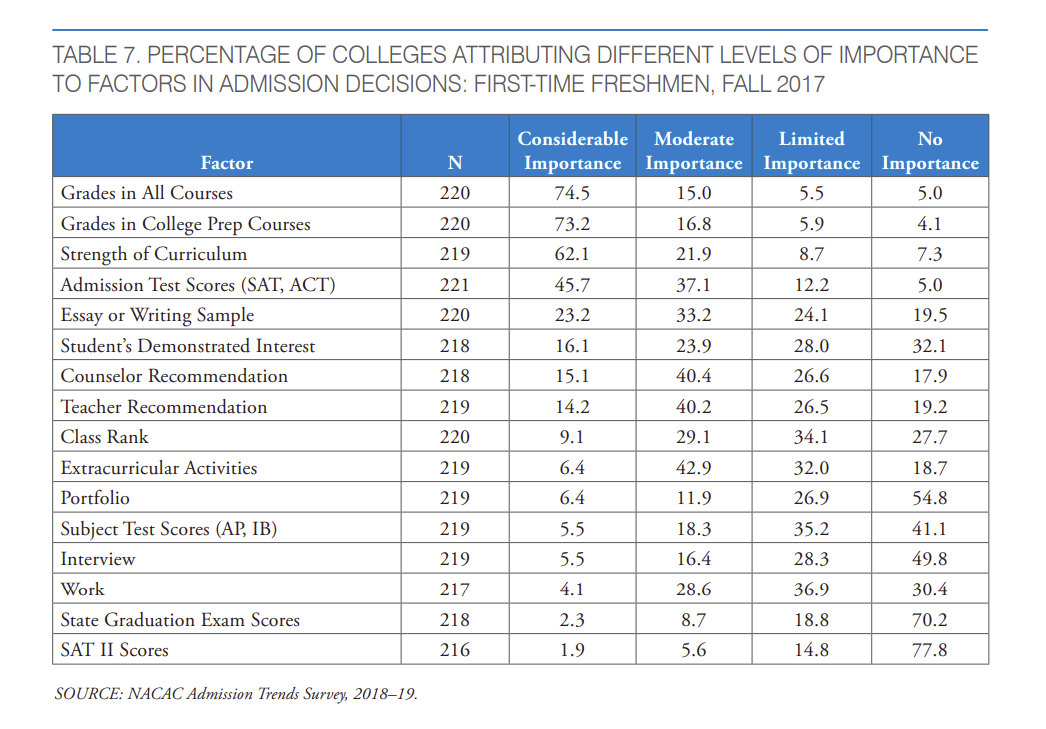


Source: NACAC


While most colleges worldwide accept students based on grades (or class rank) and scores on a standardized test, top American colleges are unique in how they select their future students. 


Grades, admissions test scores (SAT/ACT), the strength of curriculum (performance on Advanced Placement exams, for example), and recommendation letters are all carefully evaluated. An essential part of an application is often comprised of the non-academic portion of your profile – extracurricular activities, examples of leadership, community service/volunteering, internships, research, work, talents/awards. Along with listing them, you would humanize your experiences in college essays that are designed to explain how you grew and contributed; and what you learned. 

Admissions factors updated for the test-optional world


During the pandemic, many colleges were forced to experiment with test-optional policies as students could not physically take the SAT or the ACT. Many institutions continued with the policy subsequently as a social justice matter, although some elite schools, such as MIT and UT Austin began requiring SAT/ACT scores.

NACAC updated its admissions factor table in 2023 to reflect this development. Test scores do not appear in this table:


Race, gender, and ethnicity

As American colleges and universities move to equalize opportunities to help create a more diverse society, all of the above merit factors begin to pale in comparison to the one metric that is so hard to measure: a student's background. This huge catch-all umbrella includes various measures that a student can't control, such as gender or race, and the so-called adversity score, which measures such intangibles as family structure, housing, educational attainment of the community, and the likelihood of being a victim of a crime.


The theory is that students who overcome disadvantages and still do reasonably well in high school deserve a shot at admission to the best colleges over those students who are more privileged and may even have a better student profile overall, partly because of the privilege. Studies have shown that regardless of a student's background during high school, graduates from an elite institution such as Harvard or MIT all do equally well, get the best positions in business and industry, and continue leading productive careers. 


Elite Schools' Supply & Demand equation


Demand: There are 26,000 high schools in America, and each has a valedictorian, the student ranked #1. Besides the salutatorian, the student ranked #2 also deserves nearly the same recognition because, over four years, these two students would have often traded places with each other. This makes the group of over-achievers a total of 52,000 students. There are also 15,000 National Merit Finalists (NMF) — admittedly, some who include the class valedictorian and the salutatorian — who are chosen based on the highest scores achieved on the PSAT-11 test. The finalists must also go through additional scrutiny and a review of supplemental essays, school recommendations, and overall academic merit. This means that there are nearly 67,000 academic over-achievers across America. And our simple model here omits every other merit student outside of the valedictorian, salutatorian, and an NMF finalist.


Supply of seats:
The combined freshman acceptance of all eight Ivy League schools is about 16,000 students. Discounting this number by international students, who comprise about 25% of each incoming Ivy League class, the effective number of elite seats available to American students is only about 11,000.

During the last 25 years, the number of elite college admission seats has remained the same. So, at a macroeconomic level, this is a classic supply and demand imbalance problem, tilting heavily to the demand side while the supply stays the same.


And there's brutal competition for these prized seats. Consider Asian-American students, some of the most high-performing teenagers striving to enter elite institutions. According to the Census Bureau, the Asian-American population increased from 10.4 million in 2000 to 18.9 million in 2017, an 80 percent increase in a generation.

For the class of 2023 and in recent years, many of these superstar high school students never made it to even one of their choice Ivy League schools.

How to increase your odds of elite admission


High-school students must start carefully strategizing about their roadmap to an elite school four to five years before submitting their college applications. Students must have outstanding academic metrics: GPA, SAT/ACT scores, strength of curriculum, and class rank.

They also have to be the best in school and extracurricular activities. They must demonstrate character by being on the school's athletic or debate teams or representing their school in band, orchestra, or drama. They should show leadership by being elected to a position of importance in student government, being selected as ambassadors, or working on the school's newspaper or yearbook team. They also should demonstrate a passion for a skill or talent, such as playing the violin or creating art. 

And they must engage in community service, such as serving those in need or older adults.

Most students from privileged families strive to build impressive overall profiles, shunted from activity to activity by caring parents.

Applying Early Decision is a crucial strategy to help lift an application over the top, but doing so comes with its own drawbacks. Also, it may be better for Asian American students to not disclose their race on the Common App.


The new definition of 'student promise': Overcoming adversity factors

Americans of all stripes and colors want a fair shot at their pipe dreams. Income inequality is a real issue, and elite colleges are trying hard to address decades of systemic injustices to look at students and evaluate merit differently.


For students who face adversity at home — and who belong to under-represented minority populations — colleges generally exempt them from having to build their extracurricular profiles in the manner described above. For these students, taking care of a sibling and doing chores around the home when a single parent goes to work are far more relevant than perfecting skills on the violin. Even work experience — earning a paycheck at a McDonald's to support the family income — is weighted significantly higher than many traditional extracurricular activities pursued by "privileged" white or Asian-American students.


Because decades of data show a strong correlation between adversity and race, colleges have used adversity as a code word to admit more students from under-represented minority Black, Hispanic, and Native American populations at the expense of white and Asian American students. 


Until twenty years ago, America's elite colleges largely considered only an applicant's accomplishments. In that sense, American institutions were more like professional sports leagues. Imagine if the qualifications to be ranked as a Top-100 tennis player had a "race" component in addition to matches won or lost. Such an idea would have been immediately dismissed. 


This conflict is at the heart of the Supreme Court case against Harvard and UNC-Chapel Hill, brought about by Edward Blum, founder of Students for Fair Admissions, the plaintiffs in the court cases against Harvard and the University of North Carolina. In a landmark 2023 decision outlawing affirmative action, the United States Supreme Court ruled that colleges should not admit students based on race or any other factor common to a group. Individual merit should prevail.


 A Note About Rao Advisors Premium Services
Our promise is to empower you with as much high-quality, ethical and free advice as is possible via this website.  But parents and students often ask us if they can engage with us for individual counseling sessions.

Individual counseling is part of the Premium Offering of Rao Advisors and involves a fee.  Please  contact us for more information.


Math and calculator tips for the SAT/ACT


By Jatin Rao


TI-83 Calculator. Image Credit: Rao Advisors LLC


The highest math level that is expected to be tested on the SAT is Algebra II, meaning that the questions are generally easier and less complex than the math questions on the ACT, which includes precalculus content as well.

There are 4 math subjects that are tested on the SAT Math section: 
 
  1. Heart of Algebra: This section mostly covers topics that are taught in Algebra I, and the questions are heavily focused on solving basic linear equations and linear inequalities. Mastering this section in Khan Academy is vital before moving on to practice the other two sections. There is also heavy emphasis on analyzing and interpreting graphs.
     
  2. Problem Solving and Data Analytics: This section includes some Algebra I topics, but also includes basic statistics and proportions problems. It is key to remember concepts such as mean and median, ratio laws, and exponent rules.
     
  3. Passport to Advanced Math: This section is almost all Algebra II topics and relatively advanced geometry. Most of the questions will require manipulating equations and solving for a single variable, thus requiring the most practice overall.
     
  4. Additional Topics: This section mostly covers Geometry topics and complex numbers. It is important to remember concepts such as the unit circle and other widely-used geometric theorems.

There are two subsections on the SAT Math test, a Calculator and a Non-Calculator section. The calculator section questions will generally be harder than those on the non-calculator section, because the College Board knows that the test-taker has a tool to help with calculations.
 
Non-Calculator: The section without a calculator comes first. There are 20 questions and a time limit of 25 minutes. Most of the questions are multiple-choice questions, with a few grid-in questions at the very end. Because this section is generally easier, expect questions from the Heart of Algebra, Data Analytics, and Geometry sections, but be prepared for some tricky algebra or manipulation questions. There will be some graph questions but not as many as the Calculator section. A lot of them will be simple "one-line" questions that only take a few seconds to read and roughly 30 seconds to solve, so it is important to prioritize picking up easy points on questions like these before moving on to the harder problems. 

Calculator: This section appears after the Non-Calculator section. There are 38 questions with a time limit of 55 minutes. There is a generally better spread of questions across the 4 sections, but the questions are more difficult because of the student's ability to use a calculator. Not all questions will require usage of the calculator, so try and save some time by not using it if possible.

While Precalculus topics will not be tested on the SAT, it is preferred that a student has taken Precalculus before taking the test. We recommend accelerating through one of the three preliminary math courses (Algebra I, Geometry, Algebra II) in order to make space for the student to take Precalculus during his/her sophomore year, and then take the SAT during the summer between the sophomore and junior years, preferably in August. Precalculus does an excellent job of acting as a comprehensive review course for the topics learned in all of the three preliminary math courses, so the student will have the ability to review concepts learned years prior, as well as learning useful new concepts such as the unit circle and trigonometric manipulation and proofs. They will also have the benefit of practicing problems at a higher skill level to prepare for more difficult questions on the SAT and ACT.

Of the two mainstream choices for calculators for standardized testing, the TI-83 Plus and the TI-84 Plus, which do we recommend using?

There are actually only a few differences between the TI-83 Plus and the TI-84 Plus, with the latter offering a few additional features and an improved screen interface for the user. Students should also consider the TI-84 Plus CE (color edition), which is the same as the TI-84 Plus, but with a smaller feel and a colored screen that can make graphs easier to interpret. There are also a few more built-in applications on the color edition TI-84.
.
SAT - The TI-83 Plus works just fine. Most of the calculations will be simple PEMDAS or graphing, and therefore will not require any of the advanced tools that are present in the TI-84. Be familiar with the functions in the MATH tab on the calculator, and how to store values and recall them later for more complicated solutions. Become an expert at quickly graphing functions using the "y=" tab, and analyzing the graphs using the TRACE and CALC tabs at the top right. Some of these may help solve some problems faster than doing the math on paper.

ACT - The TI-84 Plus is preferred over the TI-83 Plus. Because precalculus topics are tested on the ACT, it is useful if you can calculate summation formulas and type in complex fractions without the use of many parentheses that could confuse you. Pressing ALPHA + "y=" will open up a menu that can simplify entering fractions into the console. Functions like entering complex roots that are more than the square root, finding the logarithms of functions at a different base than 10, and using the many statistical tools in the STAT tab are all available in the TI-84 Plus, and will likely be used many times during the ACT Math section, where time is of the essence.

AP Exams - The TI-84 Plus or TI-84 Plus CE is the preferred choice. Heavily math-based AP exams like AP Physics, AP Chemistry, and AP Calculus BC will have several complicated problems that require the extra functionality that the TI-84 Plus calculator provides. Make good use of the built-in applications within the APPS tab, which has features that range from converting units to creating vectors to graphing vertical x functions. Especially for the AP Calculus test, being able to graph polar equations, differentiate multiple graphs by colors, type out long summation formulas, and entering integral equations in the TI-84 Plus CE is a big plus.

Overall, the TI-84 Plus color edition is the best calculator that offers many more useful features than the other models and it can be used for all three tests. Plus it can easily travel with the student to college.


A Note About Rao Advisors Premium Services
Our promise is to empower you with high-quality, ethical and free advice via this website.  But parents and students often ask us if they can engage with us for individual counseling sessions.

Individual counseling is part of the Premium Offering of Rao Advisors and involves a fee.  Please contact us for more information.


Jatin Rao Bio


Jatin Rao


Go back to About Us

Jatin Rao has served, since 2017, as an associate at Rao Advisors LLC, a Texas firm to counsel students about all things college:  readiness, financial planning, selection, strategy and admissions. He currently runs all finance operations for the firm, including invoicing, the creation of quarterly reports, and collections. 

He has spoken at numerous customer webinars and in-person seminars on the road, usually in Austin or Houston, about high school preparedness. He fields audience questions from students and parents after live presentations; develops Excel models that chart college admissions data through blog posts on the firm's website; and provides advice to families about test-prep and high school course navigation during one-on-one counseling sessions. 
 
Jatin is a senior at the University of Texas Canfield Business Honors program and a recipient of the Susie and Skip McGee Endowed Presidential Scholarship in Business. He was recognized by UT with the Distinguished Honors designation for each year from 2020-2022. For 2023, he is a College Scholar. He served as the Director of the UT University Finance Association and is an active member of the Texas Energy Capital club. He has accepted a position at Jeffries Investment Bank in Houston as an analyst after he graduates in May 2024.

Jatin is interested in Japanese culture and earned a certificate in Japanese by completing 24 credits at UT. He is an avid sports fan having co-led his high school's varsity tennis team. He is a devout ping pong player and likes to analyze football, ice hockey, and baseball.

In high school, Jatin was a finalist in the National Merit Scholarship competition in 2019-20, the only student in his graduating class of 726 students to win the distinction. He was chosen by his 26,000-student school district to serve as a student Ambassador. As co-captain of his school's Quiz League team, he won the inter-scholastic tournament as a Sophomore, and a runner-up place as a Junior. He was his school's only National AP scholar completing 15 AP courses with twelve 5s and three 4's. He scored a perfect 36 on his Math and Reading ACT sections, and a 790 on his Math SAT.
 
Jatin can be reached by email or phone: 682.401.5281.


How Important Are College Rankings?


By Rajkamal Rao  


Ranking anything in the US is big business.  Cars, hospitals, colleges, phone companies, home builders and consumer products are all ranked by various media outlets and customer satisfaction companies.  

Consumers crave for rankings because it makes it easy for them to sift out good products and services from bad without having to do any product research themselves.  The organizations which are ranked covet these rankings and go to extraordinary lengths to appear high up in those annual lists.

When it comes to college rankings, our position is rather radical.  We strongly believe that for most students applying to U.S. college and graduate schools, rankings don't matter much at all.  There are far better ways to choose colleges than to use school rankings because there are just too many issues with current commercial rankings. We list them after the YouTube clip below.

Our approach is to not use rankings at all and look at what real students do when they receive offers of admission. The College Navigator, a world-class site operated by the U.S. Department of Education, maintains selectivity and yield numbers for all colleges in the admissions tab. Selectivity and Yield are critically important metrics in the higher education sector. Colleges with the lowest selectivity and highest yield are obviously the most sought-after institutions, and therefore, are ranked very high. Watch the clip below.


Why we don't use rankings

We promised ranking enthusiasts that we will explain our skepticism, bordering on cynicism, about college rankings - so here we go:

Problem #1:  Does the methodology make sense?

There are about a half a dozen outfits which publish college rankings.  Every outfit uses its own methodology to arrive at a rank.  U.S. News, the largest and most popular college ranking organization, says that it gathers and weights data from each college on some 15 indicators of academic excellence, such as:

  1. Graduation and retention rates (22.5 percent)
  2. Faculty resources, such as salary and class size (20 percent)


The weights reflect U.S. News' judgment about how much each measure matters.   Just as anyone who has played around with an Excel sheet knows, if you change the weights, the rankings would change too.  So, the first step in accepting U.S. News rankings as the Holy Gospel is that you agree that its indicators and the weights are just as meaningful to you as they are to U.S. News.

For most people, this is a problem.  Most students go to college or graduate school not only for the experience of learning and exploration, but also, to find better employment after graduation.  But the U.S. News ranking methodology does not consider how employers rank the school!  Nor does it include graduate placement statistics - details about how many (and the kinds of) jobs students got after graduation.  If the most famous ranking outfit does not think graduate outcomes are important, something is wrong!

Here's an excellent article in the NY Times in which a Columbia professor of math challenges Columbia's ranking. Here's his full 22-page post. And another article in the Wall Street Journal (subscription required) that describes how Columbia and other top universities pushed master’s programs that failed to generate enough income for graduates to keep up with six-figure federal loans. Columbia is one of the highest-ranked schools by U.S. News and such a high ranking probably influenced many students to sign up for programs that clearly did not produce promised outcomes.

Problem #2:  Ranking is not the same as reputation

We do not need any publication to tell us that elite schools such as the Ivy Leagues or Stanford, MIT, Caltech, Berkeley, Duke, Rice and Carnegie Mellon are outstanding institutions of learning.  We already know this fact.  This kind of reputation is earned over decades (and in the case of the Ivy Leagues, centuries) of hard work and accomplishment.  In a sense, reputed schools are famous - for being famous.

Rankings, however, ebb or flow with the tide.  It is nearly impossible to take an institution with millions of complex interactions involving its management, faculty, students, parents, employers and trustees for nearly a year — and reduce them all to a number.

There’s also the question of how valid the underlying data - for all these interactions - is.  Most ranking outfits rely on the schools to provide them with information — such as admissions figures, financial resources, graduation figures and alumni giving — because a transparent, central hub of data does not exist. This creates an inherent conflict of interest.  If a school is truthful in its reporting to an external organization, it could potentially end up being ranked lower.  Should the school be truthful or aim to manipulate data a bit so that it can end up being higher?   When perfect data is not available, every ranking organization makes assumptions to compute scores.  Are these assumptions all valid?

The Obama White House criticized this approach in a September 2015 fact sheet as old and static, not consistent with what families and students need.  “The old way of assessing college choices relied on static ratings lists compiled by someone who was deciding what value to place on different factors”. [Emphasis ours].

Problem #3:  Commercial school rankings are, well, commercial

A key issue about commercial school rankings is exactly that — that is, these rankings are produced by commercial, for-profit companies, which love the status-quo.  The ultimate goal of these outfits is to sell their rankings or build a brand around them.  In 2007, the US News site was regularly getting about half-a-million hits a month.  Within three days of the rankings release, traffic went up to 10 million page views, a twenty-fold increase. In 2010, the company walked away from magazine publishing altogether focusing instead on its rankings business.

Another problem with rankings is that students are placed in the uncomfortable, counter-intuitive position of choosing a ranking system before choosing a school.  Each organization uses its own method to rank, so which ranking system is best for you?  If the school you like is ranked high in a few lists but ranked lower in the others, what should you do?

The Obama administration set out to correct these flaws.  Rather than rely on surveys and snapshots of data as the ranking outfits do, it proposed to use real data to rate the quality of colleges.  Every student who takes a student loan is lodged in the Department of Education database.  If a student transfers to another school, this information is also reported to the government. Every student who graduates and begins a career has to file a W-4 withholding form, so the IRS knows where this student went to work and how much she is making.  If a student failed to make loan payments over a consistent period, this information is also known to the government because the IRS has the power to divert tax refunds to unpaid loan amounts.

Problem #4:  The establishment likes the status-quo

With advances in data sciences and computing power, the government has the ability to come up with a technological solution to tie all of these disparate pieces of real information into a comprehensive ranking system that is based on actual data and not subject to commercial interests.  In 2013, President Obama announced that all 7,000 of the nation’s colleges would be ranked by the government.  As the New York Times reported, the aim was to “publicly shame low-rated schools that saddle students with high debt and poor earning potential.”

But the plan ran into fierce opposition. “Critics, including many of the presidents at elite private colleges, lobbied furiously against the idea of a government rating system, saying it could force schools to prioritize money making majors like accounting over those like English, history or philosophy.”

This type of thinking is at odds with the outcome based selection approach we have advocated for years.  If students are really passionate about subjects like English, history or philosophy, they may still choose careers in those fields but this should not stop them from knowing how much they may earn after graduation, or that the return on their college investment is likely to be poor.

The Obama White House succumbed to this pressure from the entrenched establishment and when the new College Scorecard was released in September 2015, it did not have a ranking system. The Trump administration did nothing to correct this issue. And it is unlikely that the Biden administration will rank colleges using outcome.   

Problem #5: The conflict of interest is paramount

Ranking outfits must rely on colleges to provide data and self-declare it as authentic. This presents a conflict of interest because some institutions could submit faulty data in the hopes that ranking outfits do not catch it. The result could be better rankings.

According to an indictment of Temple University's Fox School of Business by the U.S. Department of Justice, "relying on the false information it had received from Fox, U.S. News ranked Fox’s OMBA program Number One in the country four years in a row (2015 – 2018). U.S. News also moved Fox’s PMBA program up its rankings from No. 53 in 2014 to No. 20 in 2015, to No. 16 in 2016, and to No. 7 in 2017."


Our takeaway

Students are better off to use rankings sparingly and more as a final filter, if at all, rather than as a crucial pivot throughout the process.  Outcome based ranking lists, such as those from the College Scorecard (although not ranked) or Payscale.com are far better than commercial ranking lists because they keep your focus on the Return on your College Investment.

The best approach is to use selectivity and yield numbers from the College Navigator and base your decision on what other students do.


A Note About Rao Advisors Premium Services
Our promise is to empower you with high-quality, ethical and free advice via this website.  But parents and students often ask us if they can engage with us for individual counseling sessions.

Individual counseling is part of the Premium Offering of Rao Advisors and involves a fee.  Please  contact us for more information.

Go back to "Rao Advisors - Home".