Texas Public University System


By Rajkamal Rao  


Source: Wikipedia


The State of Texas boasts one of the most comprehensive higher education systems in the country. Did you know that there are 40 public universities spread across multiple systems?

When choosing schools to match your profile and risk, start from the flagship universities from each system - and then choose from the other schools in each set as needed. Example: UT Austin, Texas A&M College Station, Texas Tech Lubbock, UT Dallas, and Tarleton State.


The University of Texas System
  1. UT Arlington
  2. UT Austin - Flagship
  3. UT Dallas
  4. UT El Paso
  5. UT Permian Basin
  6. UT Rio Grande Valley
  7. UT San Antonio
  8. UT Tyler
  9. UT Southwestern - Health
  10. UTMB Galveston - Health
  11. UTHealth Houston
  12. UTHealth San Antonio
  13. UT MD Anderson - Health


    Texas A&M University System


  14. Texas A&M College Station - Flagship
  15. Tarleton State University
  16. Texas A&M University Corpus Christi
  17. Texas A&M University San Antonio
  18. Texas A&M University Kingsville
  19. Texas A&M University Galveston
  20. Texas A&M International University Laredo
  21. Texas A&M University Central Texas
  22. Texas A&M University Texarkana
  23. Texas A&M University Commerce
  24. Prairie View A&M University - HBCU
  25. West Texas A&M University Canyon


    The Texas Tech University System


  26. Angelo State University
  27. Midwestern State University
  28. Texas Tech University Lubbock - Flagship
  29. Texas Tech University Health Sciences Center El Paso


    The Texas State University System
    (There are no flagships in this set - so choose any school)

  30. Lamar University
  31. Sam Houston State University
  32. Sul Ross State University
  33. Texas State University
  34. Lamar Institute of Technology
  35. Lamar State College Orange
  36. Lamar State College Port Arthur


  37. University of Houston System - 3 Campuses
  38. University of North Texas System - 3 Campuses
  39. Texas Woman's University


    Independent

    (There are no flagships because these are independent institutions)

  40. Stephen F. Austin 
  41. Texas Southern University


A Note About Rao Advisors Premium Services
Our promise is to empower you with high-quality, ethical and free advice via this website.  But parents and students often ask us if they can engage with us for individual counseling sessions.

Individual counseling is part of the Premium Offering of Rao Advisors and involves a fee.  Please  contact us for more information.


A Letter to the Parents of the Class of 2027


By Rajkamal Rao

Updated: March 3, 2026


Rajkamal Rao, MD, Rao Advisors LLC

Since 2014, Rao Advisors has guided families through the complex college admissions process. We are proud to remain a Google 5‑star small business for seven consecutive years.

For the Class of 2026, many of our 136 clients earned admission to top institutions including Cornell, Rice, Vanderbilt, WashU, USC, Northeastern, Berkeley, and several direct MD/DO programs. Many also got into leading public universities such as UT Austin, UCLA, Georgia Tech, UIUC, UC San Diego, Michigan, Purdue, Texas A&M, Indiana, Florida, and Virginia.

As the Class of 2027 begins its college admissions journey, I want to share what to expect over the next few months.

The Four Components of Your Student’s Brand


If you have been a client of ours for some time, recall that we helped build your student’s brand using our 4‑year roadmap approach. As your student enters the 12th grade, we now help you market that brand to colleges. Think of these components as four cylinders of a finely tuned engine:


BMW X3
 
 
Cylinder 1, Core Academics: Your student’s cumulative end‑of‑11th grade record (WGPA, class rank, AP Capstone, etc.) forms the foundation. Please review our post: What colleges look for in high school students.

Cylinder 2, College Admission Tests: Tests validate GPA in an era of grade inflation. The PSAT‑11, SAT, ACT, and AP exams are independent, merit‑based assessments.

Test‑optional policies are disappearing; many top colleges, including UT Austin, now require scores. For test‑optional schools, we will decide together whether to submit scores.

We also offer last‑minute SAT/ACT tutoring bursts for the summer test dates, ideal for students making a final push before applications open. Our rates are among the lowest in the industry, starting at $69/hr. For the latest rates, please contact us.

Cylinder 3, Extracurricular Activities: Any activity that builds skills — clubs, sports, arts, internships, jobs, research, advanced courses — strengthens your student’s profile. Review our post about how crucial extracurricular development is to a student's brand.

Cylinder 4, Volunteering: 
Selective colleges value students who demonstrate compassion and service.

The summer before 12th grade is especially important for strengthening extracurriculars. We’ve expanded our list of summer opportunities. Please visit our post here.


How We Market Your Student’s Brand

Your admissions journey begins with a mid‑June counseling session.

The U.S. Department of Education publishes detailed admissions metrics for ~500 selective institutions, including SAT/ACT percentiles and yield statistics.

Colleges also publish the Common Data Set, where box C11 shows unweighted GPA bands — a key tool for determining admission chances.

We leverage both of these resources when we share our proprietary, updated College Selection Toolkit with you.

What Happens in the First Counseling Meeting

During this 1–1.5 hour session, we will:

  • Review your student’s academics and test scores

  • Discuss strategy across in‑state, out‑of‑state, and private schools, including bucketing schools into Early Decision, ED2, Early Action, and Restrictive Early Action groups.

  • Share our proprietary College Selection Toolkit, which includes:

    • Admissions Milestones project plan

    • Early Decision analysis tool

    • Campus visit checklist

    • Essay status tracker

    • Expanded‑form resume template

    • An automated reminder‑email script that alerts families when key deadlines approach

  • Build an initial list of Dream, Core, and Safe schools

You will then refine the list on your own, considering factors such as reputation, cost, location, majors, clubs, internships, housing, and financial aid. We can join your discussions by Zoom if needed.

A key step is comparing your student’s unweighted GPA to the school’s median GPA in box C11. For Texas public colleges, this step is not generally necessary as Texas institutions rely heavily on your class rank and SAT/ACT scores, where applicable.

During this session, we will schedule a Checkpoint call schedule to review future progress. Emergency sessions are always available.

Once the college list is finalized, we ask families to create a WhatsApp group with us for fast, secure communication. We typically respond within minutes, 16 hours a day, 7 days a week. We use WhatsApp to alert you about the status of essay and resume reviews, so the group is integral to our model.

Essay Reviews: The Most Critical Component

I personally oversee essay operations, drawing on my experience as a columnist and management consultant. I currently serve on the editorial board of tippinsights and have published over 600 articles at various publications including The Hindu BusinessLine, Times of India, ETV Bharat, and the Hindustan Times. You can follow my work on Substack.

Our essay review team is comprised of 6-8 members.
We only hire strong creative writers affiliated with institutions such as Stanford, Penn, Brown, Villanova, and Duke.

For the Class of 2026, we reviewed 565 essays between Aug 1 and Oct 31. Our students have been interviewed at MIT, Caltech, Yale, Columbia, CMU, Princeton, Penn, Brown, Cornell, and Johns Hopkins, Cornell, Rice, and WashU.

Our Proprietary First Pass and Second Pass Model

We do both a first pass review (creative critique, including feedback on story clarity and voice) and a second pass finalization (professional editing for originality, completeness, engagement, delivery, and plagiarism checks) for one low price. 

First Pass:
We will provide you with genuine feedback on the creative and intellectual structure of your essay. Essays should be deeply personal experiences, with specific and concrete instances supporting your narrative. A good essay should reflect - meaning it should show what you learned and how you intend to apply your experiences, even if subtle. Duke University says that its admissions officers review submissions “primarily to understand the student’s lived experience." We will provide you with pointed, actionable tips and comments so that your essay enlivens your personal story. 

Two creative writers will review your essay during the first pass to replicate the environment of a college admissions team.  [An exception is the resume review which only includes one final pass]. 

Standard time for first pass: 48 hours.

Second Pass: You will send us your revised essay after incorporating our first pass comments to professionally edit and finalize for submission to college portals. We do an end-to-end review of every word and punctuation, checking your essay for correctness, clarity, engagement, and delivery - and for the all-important plagiarism checks. 

We will, however, not provide a creative critique of your essay's underlying idea during the second pass. We will also not validate or check that our first pass feedback was incorporated into the revised essay submission. Forcing students to accept our input would be tantamount to our ghostwriting the essay. 

We respect our clients' creative spirit. Our rules are so strict here that our second-pass reviewers never see the feedback from the first-pass comments, so they don't have to make any judgments about how much of the first pass review feedback was accepted. This step enhances the independence of the review process because the second-pass reviewer accepts a green essay with no comments, redlines, or markups when an essay is submitted for second-pass review. 

Our Active Engagement

After the college list is set, we begin:

  • Reviewing resumes and Common App activity lists

  • Reviewing essays

  • Finalizing recommendation letter and transcript requests

  • Determining score‑send strategy

  • Providing financial planning guidance

Essay reviews occur offline through Google Drive, email, and WhatsApp updates. If your student needs help choosing topics, we can schedule a short ideation session.

We also offer mock interviews, support for H‑1B families, help with petitions to schools, and guidance on choosing the best offer of admission.

Cost

Fees

Our hybrid model includes:

We remain among the lowest‑priced counseling firms in the U.S.

Estimate Your Essay Review Cost

Download our multi‑essay calculator to estimate your total cost based on the official word count for each essay. When you click the link, Google will create your own editable copy for use on your computer.

This tool allows you to:

  • Enter all of your essay requirements in one place

  • Automatically calculate units and estimated cost for each essay

  • Track the status of every essay through our two‑pass review cycle

  • Stay organized with a clean, color‑coded workflow

It’s the easiest way to understand your total essay workload and plan your review budget.

Order Your Essay

You may order your essay from our essay shopping cart page.

Submit Your Essay

We only accept submissions through Google Docs for secure, real‑time collaboration. We do not accept Word documents or .pdfs.

Submit your essay using this form: https://forms.gle/rBRGUuJnyqXhYJ7Q8


Example: Full Counseling Estimate For Texas Public Universities

My daughter wants to apply to UT Austin, Texas A&M, UT Dallas, and the University of Houston only. How much should I budget in total?

Answer: Click here for a graphic and see below for the explanation.

  1. Assume four hours of counseling. At $199 per hour, this would be $796.
  2. The resume review is $189.
  3. UT Austin and Texas A&M are two universities with demanding essay requirements. UT Austin accepts the Common App #7 (650 words). This would cost $377.
  4. Texas A&M only accepts the ApplyTex Topic A essay (750 words) although it uses the Common App platform. This would cost: $435. 
  5. UT Austin has two supplements of 300 words each. Total cost: $348
  6. Texas A&M has two main supplements of 250 words each. Total cost: $290
  7. Texas A&M also has plus five stealth scholarship supplements, totaling 750 words. Total cost: $435. 

UTD and the University of Houston do not require platform essays, but we recommend submitting the Common App essay anyway since you would have already paid for it. Submitting Common App essays to these last two schools increases your chances of obtaining an institutional scholarship, like the UTD AES.

In the above example, your total budget would be $2,870. We remain among the lowest-priced counseling firms in the United States.

Next Steps

As always, we will pause services for younger grades between Sep 1 and Nov 1, the busiest period of the admissions season. If you have a younger one needing help, we ask you to book appointments outside this window.

I look forward to working with your student. Good luck!

​Rajkamal Rao


A Note About Rao Advisors Premium Services
Our promise is to empower you with high-quality, ethical and free advice via this website.  But parents and students often ask us if they can engage with us for individual counseling sessions.

Individual counseling is part of the Premium Offering of Rao Advisors and involves a fee.  Please contact us for more information.


How do you prepare for the SAT/ACT?


Image by Rao Advisors

 
We're often asked - what is the best way to do well on the SAT/ACT? Here's the 35,000 ft. overview.

  1. Pay attention when you sign up for the SAT: When registering for the SAT, the first time or the nth time, ALWAYS leave the list of four free college score recipients blank. Why would you want a school to know your scores before you know how well you did?
     
  2. Complete the test trifecta: Take your SAT in August between the 10th and 11th grade (prior-prior year of high school graduation); and the ACT in September, so that you are well-prepared for the all-important PSAT-11 in October. The PSAT-11 is also the qualifying test for the National Merit Scholarship competition. 

    If you do well on the SAT or the ACT, you never need to take those tests again! This frees up time for 11th grade academics and extracurricular activities.

  3. Take the test(s) only once: Prepare well, take all the official mock tests at home; postpone the test date if you must, but take the test(s) only once. See our post here.

  4. Practicing rather than studying: All three tests are measures of scholastic aptitude. Algebra II/Pre-Calculus courses will have provided you with a solid Math foundation. Your English II, AP Human Geography, and AP World History learning experiences will have given you an excellent English foundation. So, you prepare for these tests more by practicing than studying.

  5. Practicing is a two-step process: You sharpen the knowledge and skills required by practicing the content of the tests; and then, you sharpen your test skills by practicing on the tests themselves. These two are related activities but wholly different. 

  6. Exploit free resources: The Khan Academy, the College Board, and the ACT Academy are outstanding resources for practicing content – free, and official! Even tutor-learner online sessions are free, thanks to Schoolhouse.world, launched in Jan 2021. To practice test-taking, both the SAT and ACT offer numerous free official mock tests, tests that were previously administered. 

  7. Practice with a trusted peer: Students often under perform not because they lack ability, but because they lack consistent practice, accountability, motivation, engagement, and peer reinforcement. 

    When a student learns with a peer, they show because their partner is counting on them. Peer learning increases motivation and reduces tutoring fatigue. Explaining concepts to a buddy deepens mastery. These tests are timed and competitive, so practicing with a peer simulates test pressure.

  8. Invest in diagnostics and forensic analysis: When you practice test-taking, find out why you got a wrong answer, and close the learning gap before you take the next mock test. Review point #6 in the step-by-step instructions below.  

Taking Practice Tests


Here are excellent tips developed by the College Board for the digital age.

Taking a full-length practice test on Bluebook is one of the best ways to prepare for the real test. Digital practice tests simulate the real test experience, including adaptive modules and built-in tools (like highlighting and answer elimination). [Paper practice tests are still useful for content review, but they don’t reflect the new format or timing]. Our advice is that you prioritize digital practice tests.

The College Board offers 10 full-length digital practice tests through the Bluebook app. These include:
  • Practice Tests 4–6: Previously available digital tests
  • Practice Tests 7–10: Newly added in 2025, combining fresh questions and select items from the original paper-based Tests 1–3
  • Note: Practice Tests 1–3 were removed from the Bluebook in February 2025, but their content is partially reused in updates Tests 7–10.
You can find both the Bluebook digital tests and the updated PDFs on the SAT Suite Practice Tests page.

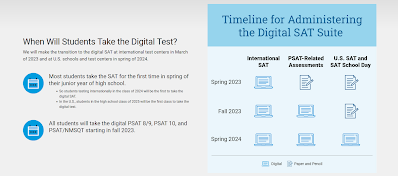
The digital test is shorter because it relies on adaptive testing. That means the test changes based on the students' answers, with the goal of reducing the time students spend answering questions that are either too easy or too hard. 


SAT Digital Suite. Image Courtesy: The College Board.


Do Colleges Prefer the SAT over the ACT?

 
Colleges are indifferent to which test you take. The concordance tables that map the ACT scores to the SAT have consistently shown that this policy makes sense. Statistically, one can be nearly 100% confident that an ACT score falls within a narrow 30-point SAT score range. 

Both the SAT and the ACT are attempting to stay relevant as there is increasing pressure from groups who lobby for the elimination of these tests altogether. Groups such as FairTest have exploited disruptions caused by Covid to convince more than 1,800 colleges and universities to go test-optional. But there are many colleges that still require the SAT/ACT for college admissions, and when test scores are submitted, colleges will consider them as one more data point to make admissions decisions. Besides, test-optional does not mean test-blind. In Texas, scoring a minimum of 480 in reading and 530 in math (Super scoring is NOT allowed) is required to avoid colleges imposing Texas Success Initiative requirements. 

Since 2024, it has become clear that the test-optional party at many top colleges is finally coming to an end. We tracked the announcements of various elite schools, including UT Austin, in this Facebook post. Colleges are beginning to realize after four years of experimentation with student admissions and performance that test scores better help predict students’ college grades, and their chances of graduation and post-college success. Grades alone are not as accurate a predictor because of issues like grade inflation that make it difficult to assess a student’s work.

Note about the ACT Science section 

STEM-focused students will probably do better on the ACT because the dedicated Science section contributes 25% to the ACT composite and will help lift the overall score up. 

In April 2025, the ACT's Science section went optional; the composite score since then is based solely on English, Math, and Reading. 

If you're strong in science and applying to STEM programs, taking the science section lets you showcase that strength to admissions officers, even though it won't affect your composite score. Most colleges view the Science section as a bonus in holistic review, with no penalty for opting out. However, some (e.g., MIT, Purdue) recommend or require it for STEM applicants. Submitting a strong Science score can provide an edge over similar candidates who skip it. Always check target schools' policies. 


Step-by-step Review of How to Maximize SAT/ACT outcomes

 
Let's review all of the tools to prepare for the SAT. The most important book you need is the Official SAT Study Guide. For ACT resources, check out our post here

  1. If you link your College Board account with the Khan Academy account, the KA website will automatically detect which areas of testing you are weak in based on your performances on the PSAT. And it will start serving up lessons and practice questions so that you can improve. 

  2. You can set your smartphone or PC to automatically challenge you with practice questions every day at a certain time. You set the frequency, the topic, and the number of questions. 

  3. Practicing content before taking full-length practice tests. The Khan Academy website is your best friend because it is the official partner of the College Board with outstanding technical features. There are loads of videos and review content if you are ever not sure about a topic area. Don't forget to sign up for free SAT instruction on schoolhouse.world. 

  4. Taking full-length practice tests. There are the full-length practice tests from the College Board (see previous sections for links) so that you can create test-day conditions in the privacy of your home.

    Timing the practice tests for maximum impact is crucial. Studying for the SAT during the summer and taking the test in August is the best solution because you do not have school obligations to interfere with test preparation.

    Say that the big Test Day is Aug 24. Refrain from taking a practice test the day before. You want to be fully relaxed and confident, so take in a movie or play your favorite video game on Aug 23. Also, never take two practice tests on consecutive days. You should set aside the day following a practice test day for diagnostics and comprehensive review - more on this in point #7 below.

    Your schedule should look something like this:

    Aug 24 - Test Day

    Aug 23 - Relax!
    Aug 22 - Diagnostics for Practice Test 10
    Aug 21 - Practice Test 10
    Aug 20 - Diagnostics for Practice Test 9
    Aug 19 - Practice Test 9
    ....
    ....
    Aug 4  - Practice Test 1


    Before taking the first practice test, you will have practiced your skills on the over 2,000 official questions on the Khan Academy website, including over 900 questions in Math. Each student is different - but you should plan on a minimum of 30 practice questions every day. Depending upon how many questions you routinely get right, and how much time you require to review video lessons to remedy those skills with which you're uncomfortable, plan on about an hour of diligent study every day. This is not a big ask - it's after all the dry, boring days of summer.

    If you plan to practice on every question (this may not be possible because of how the site allocates competency badges as you master skills for each test topic), this will theoretically take 66 days. So, working backward from Aug 4, you're looking at starting your test preparation on or about June 1, about 2½ months prior to the test date.  

  5. If you are doing paper based practice tests, you can print out the answer sheets even and use 2HB pencils to oval your responses out.To score your test, go back to the page containing the seven full-length non-adaptive paper-based practice tests. Test bundles from practice test 4 to 10 are available. 

  6. Here's the most important step: Diagnostics. When reviewing the detailed explanations for wrong answers, track if you had more than one wrong answer in a topic area, such as Congruence and Similarity (Math), or Possessive Determiners (English Grammar).

    If yes, you must go back and review the appropriate refresher video lessons on Khan Academy before taking the next full-length practice test. Many students are too eager to believe that their foundational knowledge is so strong that a remedial review is unnecessary. For well-designed tests such as the SAT/ACT, which pry on tricking students, such over-confidence could impact test-day scores.

  7. ACT Prep. If you're preparing for the ACT, check out our post.

When you are ready to report your SAT scores to colleges, please follow the detailed College Board instructions here.


A Note About Rao Advisors Premium Services
Our promise is to empower you with high-quality, ethical and free advice via this website.  But parents and students often ask us if they can engage with us for individual counseling sessions.

Individual counseling is part of the Premium Offering of Rao Advisors and involves a fee.  Please contact us for more information.


Rajkamal Rao Sports Journalism Profile


Stanford University Track. Image: Rao Advisors

 
I am a U.S.-based part-time journalist/columnist with my work appearing in Tippinsights, multiple media properties of the Hindu Group in India, and All India Radio. I write articles at https://rajkamalrao.substack.com/

I received media credentials to cover the 2020 Tokyo Olympics but I couldn't attend because of Covid restrictions.

I present below a sample of several tennis/sports columns of mine that have appeared in the press.

Rajkamal Rao - Print/online media
  1. Apr 11, 2023 - All India Radio, weekly sports roundup. WPL summary
  2. Nov 25, 2014 - All India Radio, weekly sports roundup.  Interview with Vijay Amritraj covering CTL in Bangalore.
  3. Oct 14, 2014 - All India Radio, weekly sports roundup.  Interview with Olympic Gold and World Gold medal winner Abhinav Bindra (starts at 01:30).
  4. Sep 9, 2014 - All India Radio, weekly sports roundup covering the Davis Cup pre-tie activities. At clip marker 05:27, an interview with Anand Amritraj.
  5. Other broadcasts (some in Kannada):

    1. Sep 16, 2014 - All India Radio, 10 PM, weekly sports roundup covering the Davis Cup matches.  A 13 minute clip featuring an exclusive interview with Rohan Bopanna in Kannada, starting at clip marker 06:17. 

    2. Sep 9, 2014 - All India Radio, 10 PM, weekly sports roundup covering the Davis Cup pre-tie activities.  9 minute clip featuring an interview with the Jt. Secy of the Karnataka State Lawn Tennis Association; followed by, at clip marker 05:27, an interview with Anand Amritraj in English.   
       
    3. Aug 26, 2014 - All India Radio, 10 PM, weekly sports roundup largely covering the Pro Kabaddi League game between Bangalore and Patna.  17 minute clip featuring commentary in Kannada, starting at clip marker 01:49, followed by interviews with the Bengaluru Bulls coach and the former captain of the India Kabaddi team, an Arjuna Award winner. 
     

    My official Muckrack profile is here. As a print/online columnist opining on various topics, I have written 450 published pieces and appeared numerous times as a commentator on television.
     

UT Austin dramatically relaxes essay requirements after Fall 2025


By Rajkamal Rao  


Image Credit: Rao Advisors LLC.

Update: May 22, 2024

The University of Texas will continue to accept the Common App (along with ApplyTexas), but the essay requirements have been dramatically relaxed and shortened for Fall 2025 and beyond.

Goodbye to the 650-word required essay (the growth essay) plus the three tough supplements. The dreaded "Please share how you believe your experience at UT-Austin will prepare you to 'Change the World' after you graduate" essay is now gone. There are now only two supplements. All of these changes should be good news for thousands of high school students. 


Required essay (500-650 words)

Share an essay on any topic of your choice. It can be one you’ve already written, one that responds to a different prompt, or one of your own design. 

This is identical to Common App prompt #7. It means that you can submit any essay you wish (including responses to any of the seven Common App prompts), significantly lowering your effort to complete the UT required essay.

Supplemental essays (250-300 words).

  1. Why are you interested in the major you indicated as your first-choice major?

    This has remained unchanged from Fall 2021. A good way to discuss this is to start with what triggered your interest and then pivot forward to what your intended career after college would be.

    To research careers, check out the U.S. Department of Labor's website, ONET, which contains detailed job descriptions for over 575 careers. Consider using those themes and some buzzwords back into your essay making sure not to copy content verbatim. Here's the ONET listing for Aerospace Engineers as an example. Also, don't forget to examine related careers.

  2. Think of all the activities — both in and outside of school — that you have been involved with during high school. Which one are you most proud of and why? (Guidance for students: This can include an extracurricular activity, a club/organization, volunteer activity, work or a family responsibility.) 

    This is similar to the "Experience" essay from Fall 2021 but the wording has been significantly watered down. For example, the words "describe" or "share" do not appear in the prompt, so you could be more free-flowing in your response. You could talk about your experiences, perspectives, and/or talents have shaped your ability to contribute to and enrich the learning environment at UT Austin, both in and out of the classroom. Or you can describe your "Leadership" qualities in school, a job, your community, and/or within your family responsibilities.

     
  3. OPTIONAL. Please share background on events or special circumstances that you feel may have impacted your high school academic performance. 

    We encourage students to take advantage of this prompt only if you have met with real adversity, such as a loss of job of a parent, impact to family income, perhaps, loss of life. 

    For the full list of official prompts, visit UT's Freshman Admissions website.

    For a primer on how to write essays and how we can help, click here. To learn how we help high school seniors navigate the college admissions process, click here


A Note About Rao Advisors Premium Services
Our promise is to empower you with high-quality, ethical and free advice via this website.  But parents and students often ask us if they can engage with us for individual counseling sessions.

Individual counseling is part of the Premium Offering of Rao Advisors and involves a fee.  Please  contact us for more information.


About the new Undergrad Degree in Informatics at UT Austin


By Rajkamal Rao  


Image Source: School of Information, UT Austin


Update, 02/20/2026

It looks like the School of Information which used to offer the Informatics degree at UT Austin will merge into the College of Natural Sciences. https://ischool.utexas.edu/news/prof-ken-fleischmann-lead-ischool-chair-designate-and-interim-dean

The new iSchool will be an umbrella organization for Computer Science, Data Science, Statistics, and Informatics.


The University of Texas has launched a brand new undergrad program in Informatics in its School of Information.  I reached out to Natasha V. SaldaƱa, the Undergraduate Program Coordinator, with several questions and here are her polite responses. You may contact her here.  

  1. How is the School of Information different from the MIS major at McCombs or BHP?

    Informatics is multi-disciplinary and has six different concentration areas for students to pursue.  All of them have an aspect of how technology intersects with humans. For students who are interested in CS, ECE, and MSIS, the Bachelor of Science in Informatics (BSI) is considered a STEM major.

    If you are specifically interested in Data Science we offer the Human-Centered Data Science major concentration.

    Concentration in Human-Centered Data Science

    Data is one of the most valuable commodities in the information society, and workers who can use data to gain new insights are in great demand. Diverse skills are required to collect, manage, and analyze data, as well as consideration of the great ethical responsibility that comes with collecting, managing, and analyzing data, and the importance of critical thinking skills. The Human-Centered Data Science Concentration of the B.S./B.A. in Informatics will prepare you for a career involving artificial intelligence, machine learning, information retrieval, data curation, and data analysis. The Human-Centered Data-Science Concentration includes taking Introduction to Human-Centered Data Science followed by advanced topics courses such as Data Wrangling, Crowdsourcing, Machine Learning, and Search Informatics. Choosing the Concentration in Human-Centered Data Science will prepare you for a career in which you leverage data, information, and technology to benefit society.

  2. In which college does the School of Information lie (Natural Sciences, Liberal Arts, etc.)?

    The School of Information.

  3. Do you have an Honors program associated with the Informatics degree (like the Polymath or Deans Science Honors)?

    At this time, no; Fall 2021 is the launch of the new program and we will begin to build these programs. 

  4. Can students pursue a double major?

    Yes, students can dual-degree seek. In the School of Information, there is only one major​.  Students can choose to pursue a BA or BSI. 

  5. Approximately how many students are in the Freshman class?

    For the first class, we anticipate 50-60 freshman students.  The additional 40 are internal transfer and external transfer students. 

  6. What scholarship programs do you have outside of the usual UT offerings considering that you're a relatively new degree?

    As you mentioned, we are a new degree and because of this, we do not have any established scholarships.  We are working to build these as we grow.


A Note About Rao Advisors Premium Services
Our promise is to empower you with high-quality, ethical and free advice via this website.  But parents and students often ask us if they can engage with us for individual counseling sessions.

Individual counseling is part of the Premium Offering of Rao Advisors and involves a fee.  Please  contact us for more information.


Highlights of individual counseling


 What do you get as part of individual counseling?

Stanford University. Image: Rao Advisors

We like to think of ourselves as the Amazon of college counseling!   We provide a full suite of services - high school course planning, test prep, college readiness, college selection, and admissions strategies, financial planning, advice for demonstrating student interest in colleges, structured essay reviews - from when your child is in the 8th grade to when the last college admissions offer is received.

We create a detailed customized roadmap for each child for all remaining high school years including structured plans for how to spend summer months, how to plan and manage extracurricular activities, when best to schedule the various tests, how to prepare for tests at the lowest cost and how to free up a student's time so that there is sufficient school-life balance. 

We provide numerous proprietary tools - weighted average GPA tracker, resume templates, SAT practice logs, 4-year roadmap, college selection using U.S. Department of Education metrics, and a detailed project plan for college admissions. Plus each family receives our popular, proprietary 230-page guide to elite college admissions which is the content source for our public appearances, book, and flagship online courses.  

Families have free access to our Popular Posts page along with regular updates about all things school and college on our Facebook page.  Our low-cost live paid webinars are also very popular. Finally, customers gain free membership into our growing WhatsApp community of over 300 parents.

Families come to us for help answering numerous questions. Here is a sample list of topics we cover during our sessions, tailored to the needs of your student.


 A Note About Rao Advisors Premium Services
Our promise is to empower you with high-quality, ethical and free advice via this website.  But parents and students often ask us if they can engage with us for individual counseling sessions. We are indebted and privileged to have earned their trust in matters which are so important to them. Please check out our public Google reviews to see what they say about us.

Individual counseling is part of the Premium Offering of Rao Advisors and involves a fee.  Please contact us for more information.